
Collective bargaining is the way that workers, through their unions, can negotiate the terms and conditions under which they are employed. Coverage, the proportion of employees whose terms and conditions are set by collective bargaining, varies greatly across Europe. And this figure is becoming increasingly important because a 2022 EU directive requires governments to act if coverage is below 80%. The level at which bargaining takes place also varies, with some agreements covering a whole industry, while others only cover one employer or sometimes just part of a single workplace.
Coverage
A crucial indicator of the importance of collective bargaining in each country is the proportion of employees affected by it – its coverage. But these figures are not collected on a consistent basis in the countries concerned, and, although there are reliable figures in some countries, through surveys or precise details on individual agreements, in others there are only estimates. The figures in this section and in the chart are from the OECD/AIAS database, which bring together the national figures, although it cannot remove the inconsistencies between them. 1
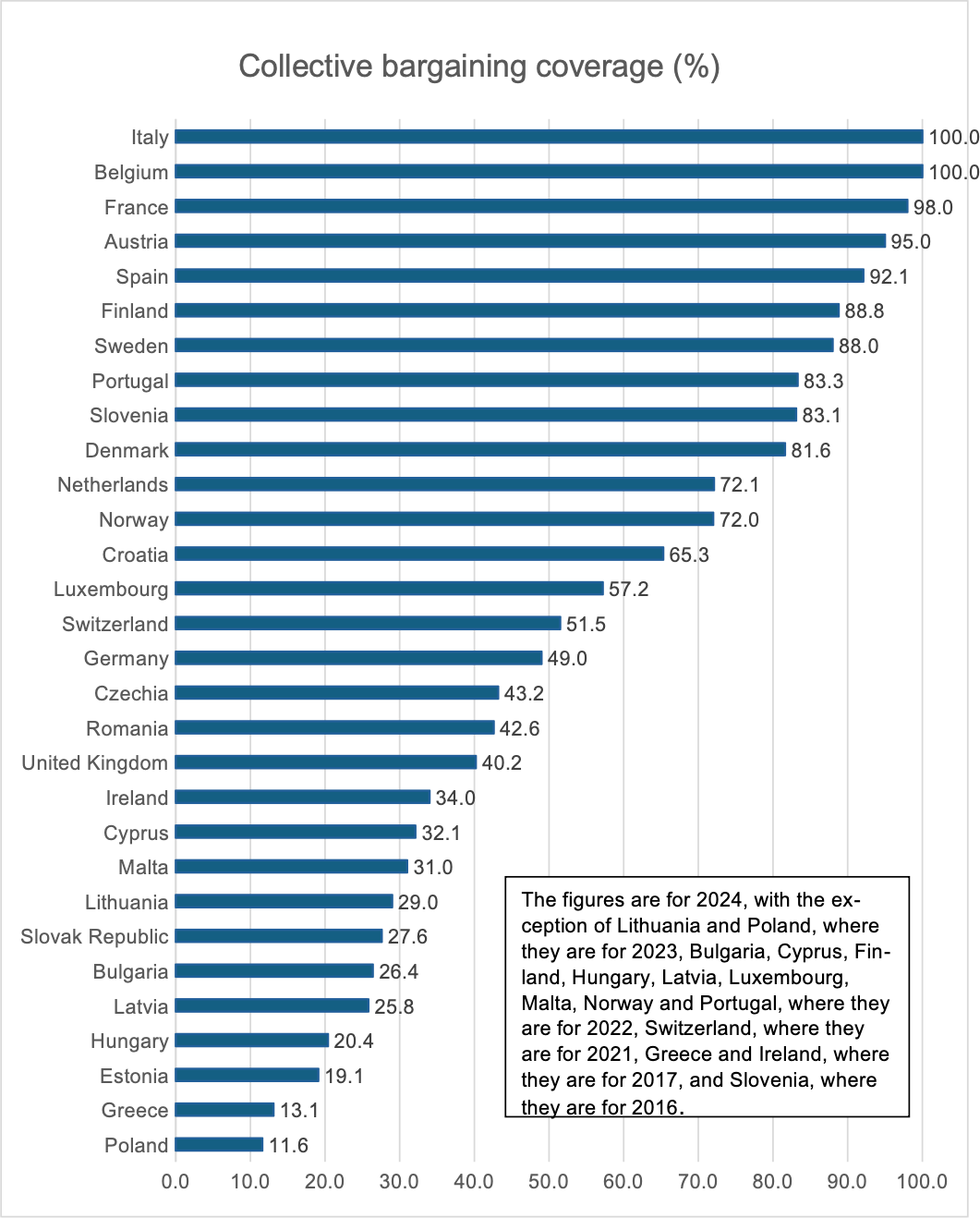
Across the EU, almost two-thirds of employees are covered by collective bargaining, although there are important variations between countries. In some, collective bargaining coverage is at or close to 100%, while, in others, it is at 20% or lower. These variations depend on a combination of union strength, the legal framework, which in many cases extends the reach of collective bargaining, and the level at which bargaining takes place.
Nordics and legal support
At the top of the table there are 12 countries where collective bargaining covers 70% or more of all employees, and they fall into two main groups. The first is the four Nordic countries, where high collective bargaining coverage goes together with high union density. The second group is made up of eight countries, where high levels of collective bargaining coverage are a result, at least in part, of the legal framework in which collective bargaining takes place. This includes either a formal mechanism to extend agreements beyond the employers and employees who initially signed the agreement, as in France, the Netherlands or Portugal, or another way in which they become generally binding, as in Italy, Spain, Belgium or Austria. (The figures for Slovenia, which also appears in this group, date back to 2016. More recent figures, published in October 2025, show Slovenia’s collective bargaining coverage at 66.3% in 2024.)
Germany in the middle
Further down the table, there are a group of seven states where collective bargaining ranges from 65% to 40% In this group, which includes Germany, mechanisms to extend collective agreements are less important, and in most there is a combination of industry-level and company-level agreements. (This is not the case in all seven states. There are no private sector industry-level agreements in the UK or Malta, while industry-level negotiations are dominant in Germany.)
Bottom of the table
At the bottom of the table there are 11 countries where collective bargaining coverage is below 35%. Except for Ireland and Greece, these are all newer EU member states, where company-level rather than industry-level agreements predominate, and, other than in Romania, union density is low. Company-level bargaining means pay is set at individual workplaces, and low union density means that most workplaces have no unions to undertake negotiations.
New directive
The exact level of bargaining coverage has become more important since 2022, when EU legislation (Directive (EU) 2022/2041) was introduced requiring member states to establish an action plan to promote collective bargaining, where bargaining coverage is below 80%. As the figures show, only eight of the 27 states are currently above the 80% threshold.
The level of bargaining
The extent of coverage is not the only issue of concern in relation to collective bargaining. The level at which bargaining takes place and the way different levels interact is also crucial, and the 30 states examined in the national industrial relations section show a variety of patterns.
In a handful of countries, a national agreement (sometimes imposed) sets a framework for private sector negotiators at lower levels to follow. This is the case in Belgium and to some extent in Spain.
In most countries, including Germany, France and Italy, industry-level negotiations set the terms and conditions for most, or sometimes all, employees covered by collective bargaining. However, there are differences in the extent to which lower-level negotiations can change what has been agreed at industry level, with Italy, for example, formally providing for productivity gains to be negotiated at company level, while in France industry level agreements often only provide minimum terms with improvements negotiated at company level or individually with employees. The legal relationship between industry-level and company- agreements has it also changed recently in several countries.
Union priority
Almost everywhere in Europe, unions have priority in signing collective agreements. (Generally other bodies representing employees, like works councils, can only sign if there is no union present.) In addition, in several countries, legislation sets out the conditions that determine which unions have a right to negotiate. These conditions, which are often linked to either union membership or support in elections for local employee representatives, are also important in determining the status of unions and union confederations.
Other issues relating to collective bargaining, such is the length of agreements the issues negotiated, tripartite negotiating structures and the existence of a national minimum wage are covered in the national reports.
- 1
Source: OECD/AIAS ICTWSS database: Collective bargaining coverage https://www.oecd.org/en/data/datasets/oecdaias-ictwss-database.html